About The NTS Virginia Section
What is the National Traffic System?
The National Traffic System®, or NTS®, is a network of amateur radio operators that facilitates rapid movement of formal traffic—or radiograms—from origin to destination throughout the United States, Canada, and other countries (where permitted). The NTS operates 24 hours per day, 365 days per year. NTS is exercised daily by volunteer radio amateurs as an open network which handles routine radiogram messages. During a disaster the NTS routine configuration is replaced by an emergency configuration designed to expedite the flow of welfare, priority and emergency traffic.
National Traffic System Virginia Tri-fold
Who Administers the NTS?
The American Radio Relay League (ARRL) and Radio Relay International (RRI) jointly administer the NTS. This includes:
· Overseeing voice and CW traffic nets
· Managing the Digital Traffic Network (DTN) infrastructure
· Developing operating standards and guidelines
· Emergency communications planning
· Developing and providing training resources
· Recruiting NTS volunteers
How Does NTS function?
NTS uses voice and CW nets, and the DTN. The voice and CW nets operate on a tiered structure: local, state/section, region, and area. These nets are time sequenced to facilitate relaying messages.
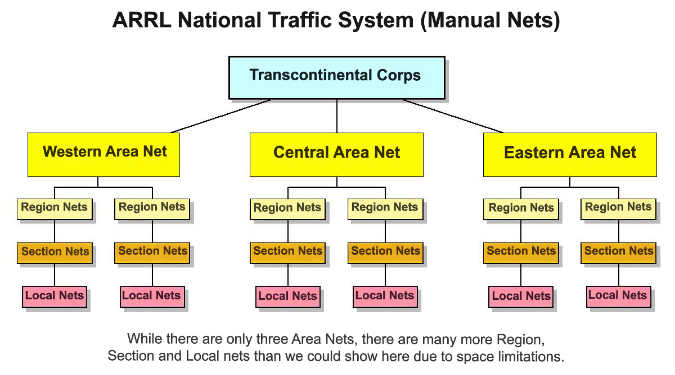
The Transcontinental Corp/Inter-Area Network exchanges traffic over long distances. The DTN runs 24-7. Together, these interoperable networks operate without critical infrastructure such as cellular towers, mobile switching offices, terrestrial facilities, distributed nodes, or other infrastructure.
Why Should I get involved in NTS?
Participating in the NTS is a fun way to improve your radio skills and serve the public. Our daily practice with routine messages ensures we are fully prepared to relay critical health, welfare, and emergency messages when disasters strike. ARRL recognizes NTS traffic handlers through multiple means including certificates, field organization appointments and designations, and the Public Service Honor Roll. [ARRL membership required.]
Radiograms
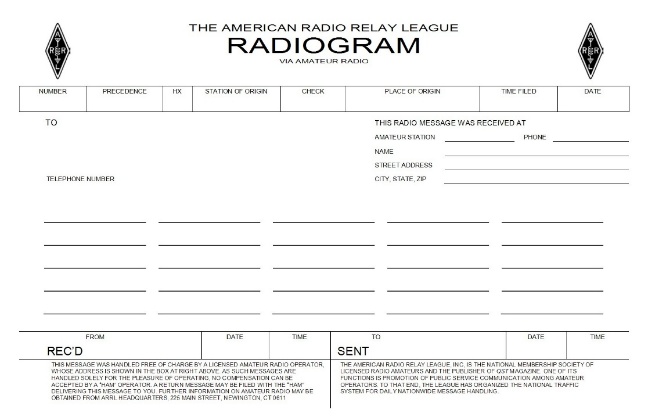
A radiogram is like a telegram. Radiograms are brief messages that are sent over radio by amateur radio operators who volunteer their time and skills in public service.
How to Send a Radiogram
There are several ways to send a radiogram:
· Checking into a voice or CW traffic net
· Accessing ARRL’s Radiogram Portal
· Through the WinLink network
· Using the RRI Digital Traffic Network (DTN)
Learn more about formatting radiograms.
For Further Information
Contact George Stone, WA1JQC, Virginia Section Traffic Manager, wa1jqc@arrl.org.